📓From the designer's desk: A first look at the Glass Hall
PLANT Architects Inc. has been working on the Mulock Park project since 2019 when the firm was selected to create the masterplan and guide the work for the transformation of the former private estate into a public hub for culture, recreation and connecting with nature.
In this post, PLANT shares some insight from the Designer's Desk on a key feature - the Glass Hall, the park's new, four-season greenhouse conservatory.
|
In the 1870s, this land and more than 200 additional acres became the summer home of Sir William Mulock – Cabinet minister, provincial court justice, University of Toronto vice-chancellor, agricultural researcher, and much more besides. His descendants lived in the manor house until 2018, when they sold the extant core of the estate to the Town. (Much of the land had by then been sold and redeveloped as a residential district.) Extensive public consultation conducted after the Town had acquired what was then known as the Mulock Property determined that the site should be converted to a public park, with an emphasis on retaining as many of its beautiful mature trees as possible, while creating spaces that would support a dynamic range of community activities.
PLANT's master plan proposed a network of focal areas that would embody aspects of the site through its millennia of history, ranging from a riverine water feature inspired by region-wide glacial moraine formation to a heritage garden that recalls Sir William Mulock’s internationally acclaimed peony garden. Other areas now nearing construction completion throughout the site include a woodland skate/walking trail (the Woodland Loop) and a Hollow Log Play Park that, in its representation of the various parts of a fallen tree, tells story of a forest’s regenerative life cycle.
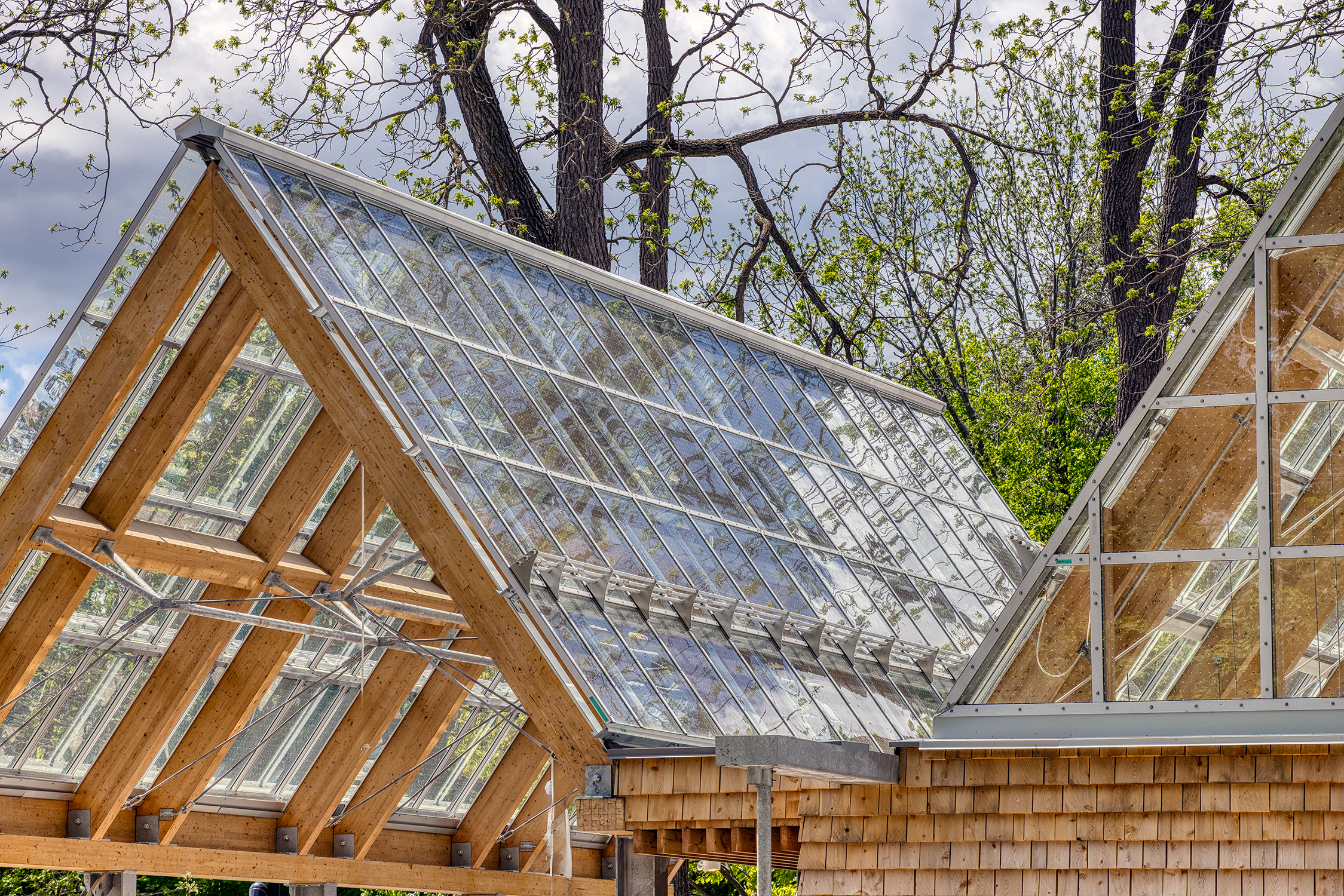
The feature area that’s first up in our countdown to Mulock Park’s opening is the Glass Hall. The fully enclosed glass-roofed volume in the photo above is a year-round space for community events that will be a lush, green oasis even in the deep freeze of Canadian winter. In the warmer months, the plants will spill out onto the glass-roofed covered patio. On the other side, sharing a courtyard with the Glass Hall is the Artist Studio, an adaptive reuse of what was once the Mulock Property’s stables. The versatile courtyard will host events and educational programming, and can also provide space for temporary outdoor art displays.

Viewed from the east, the roofs of the Glass Hall and its covered patio nestle into the trees. Steven Evans Photography
And as we wrap up this introductory post, we’ll mention that a separate, related project, guided by PLANT's master plan, is also nearing completion. +VG Architects leads the restoration and transformation of the Mulock House heritage residence. This project features a second-floor gallery in partnership with the Art Gallery of Ontario and a cafe and food service hub for the park.
The Glass Hall’s glazed roof floods the interior with light.

The transparency, wood structure, and cedar-shake cladding of the Glass Hall complement Mulock Park’s wooded landscape. Steven Evans Photography
|
|
Share 📓From the designer's desk: A first look at the Glass Hall on Facebook
Share 📓From the designer's desk: A first look at the Glass Hall on X (formerly Twitter)
Share 📓From the designer's desk: A first look at the Glass Hall on Linkedin
Email 📓From the designer's desk: A first look at the Glass Hall link